
HOUSTON—The newest advances in emissions technologies are increasingly being driven by the same goal that has always shaped oil and gas operations: improving performance.
While regulations and methane reduction targets remain important parts of the overall conversation, emissions management experts say operators show
the greatest interest in products and solutions that keep equipment running, maximize production and ideally improve profitability.
Those experts add that emissions management is becoming less about finding and repairing leaks and more about understanding and preventing the operational conditions that create them in the first place. Increasingly, that includes technologies designed not only to improve visibility into emissions events but also to improve equipment reliability and overall facility performance.
Special Report: Smart Emissions Tech
Capturing Value
Preventing or finding and fixing leaks is only one of many strategies operators
can deploy to reduce emissions while boosting profits. According to Coldstream
Energy, it’s also important to consider each engine’s emission profile, which is heavily influenced by fuel quality. Recognizing that reality, the company says it has developed a fuel gas treatment technology that minimizes the need to burn the heavy hydrocarbons often seen in field gas.
The system uses pressure swing adsorption technology to separate methane
from heavier hydrocarbons, producing a cleaner fuel stream for engines while allowing operators to retain valuable natural gas liquids that otherwise could be consumed during combustion, explains Matt Thompson, senior vice president of sales
and marketing at Coldstream.
“What we do is provide a much better-quality fuel,” Thompson says. “In the process, we are allowing operators to monetize the maximum amount of NGLs
instead of burning them.”
The emissions implications are significant, 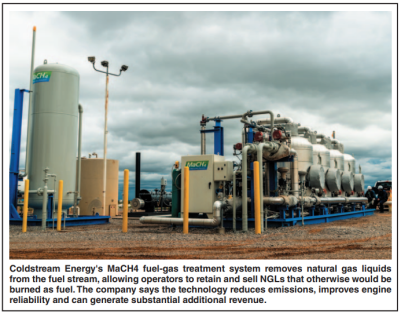 Thompson says. “The more heavies an engine burns, the worse the emissions are,” he states.
“By stripping out all those heavies, volatile organic compound emissions are
reduced by 70% on average. And because the engine has a more complete combustion process, we reduce carbon monoxide by about 20% on average.”
The cleaner fuel stream also improves engine reliability, he adds.
“The more heavies the fuel has, the more detonation you have. It’s an uncontrolled explosion in the cylinder,” Thompson explains. “Detonation will
shut the engine down, and many times it will need repairs. So when the engine
receives residue-quality fuel, the site will avoid unnecessary downtime.” Thompson says preventing downtime reinforces the already strong economic
case for preserving valuable NGLs that otherwise would be burned as fuel.
“One of our units will produce an average of about $1.2 million annually in NGL value,” Thompson says. “Without it, the station would burn $1.2 million of
recoverable NGLs. By solving that, we’re not only improving emissions, we’re creating a revenue stream.